
My Thinking
I have felt more and more disorientated by the attitude that I encounter in contemporary writing about the visual arts.
I was therefore thrilled to come across this review written by Igor Toronyi-Lolic about a book titled Against Morality by Rosanna McLaughlin.
"What Against Morality is really against... is form. And yet form is the ONLY way out. The only way to judge whether an artwork has succeeded or failed is not to force it to undertake any kind of moral MOT, but to look at it, look at it long and hard, and examine what's happening formally. Inspect what the artist is doing aesthetically with the materials at hand and the quality of the work will instantly become clear. But form is treacherous, difficult to write about and liable to make you sound unforgivably pretentious. Far safer, more socially acceptable, less work, to retreat into ... debating over Moral Maze type quandaries."
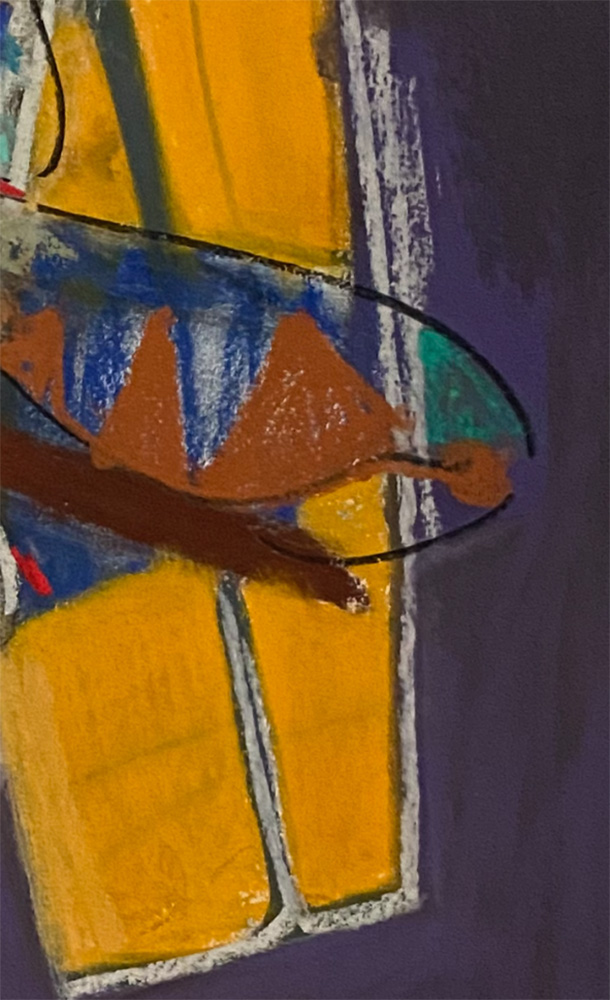
Here is a detail of (potentially) any part
Of any one
Of my pictures.
Taking a photograph on a mobile phone means that it becomes easy to enlarge,
And so isolate,
Any part of the image.
When you do this every line, and every patch or part of every image can be examined to check if it is "clear", "vivid and "alive" enough to stand alone as a potential work of "abstract art".
I believe that my pictures achieve this.
NEXT:
To become aware of how I compose my pictures I decided to select three photographs that show a "work in progress".
What emerged from this decision was how the process of clarifying the forms and linking and balancing them against each other is what creates the meaning in my pictures.
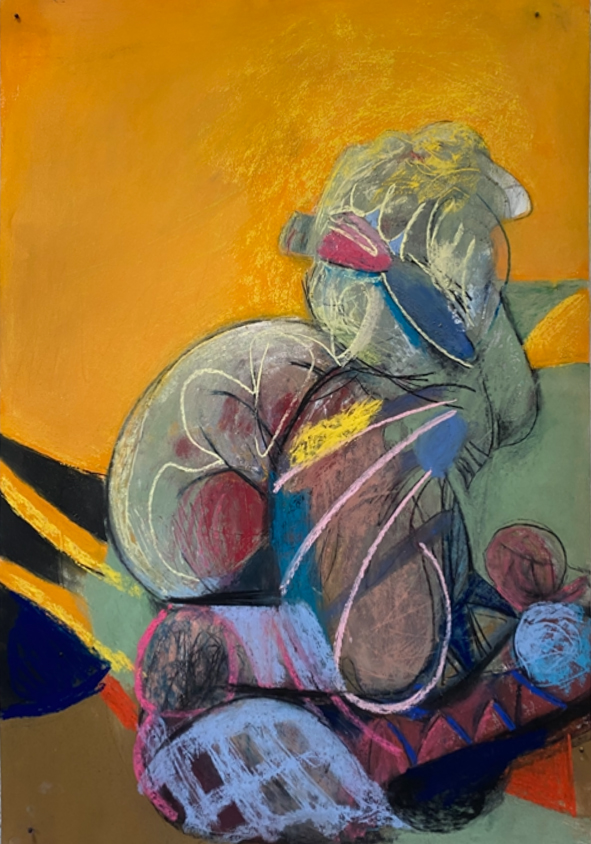
1. The image as it appeared after the first day's work.
Essentially linear patterns forming into a figure set against a very bright background.
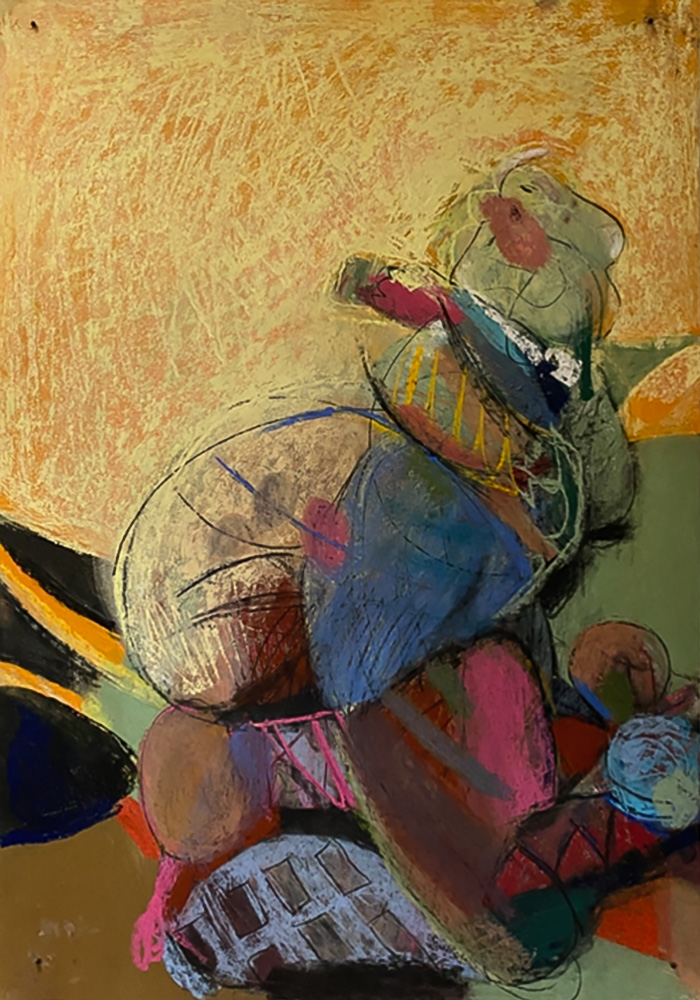
2. The image after I had spent some time working on it.
The forms have become linked together by a more uniform, consistent light, which divides the picture into an upper, light area and a lower, darker one.
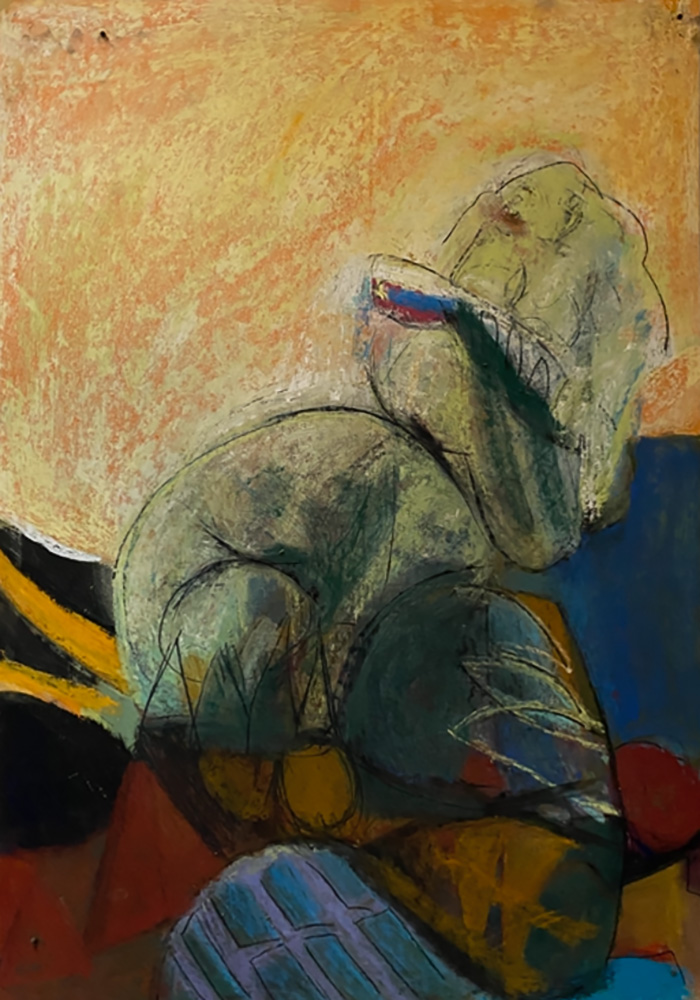
3. The image that I decided had achieved the necessary clarity and balance.
Patterns and shapes have regained some of their original clarity.
Having added "light" means that the areas forming the body have become more 3D.
3D in turn adds "weight" and here weight has added precariousness to the balance.
However the overall, unifying concept remains "light".
Areas are held into the overall visual pattern by how "light" is reflected, absorbed, or projected by each element.
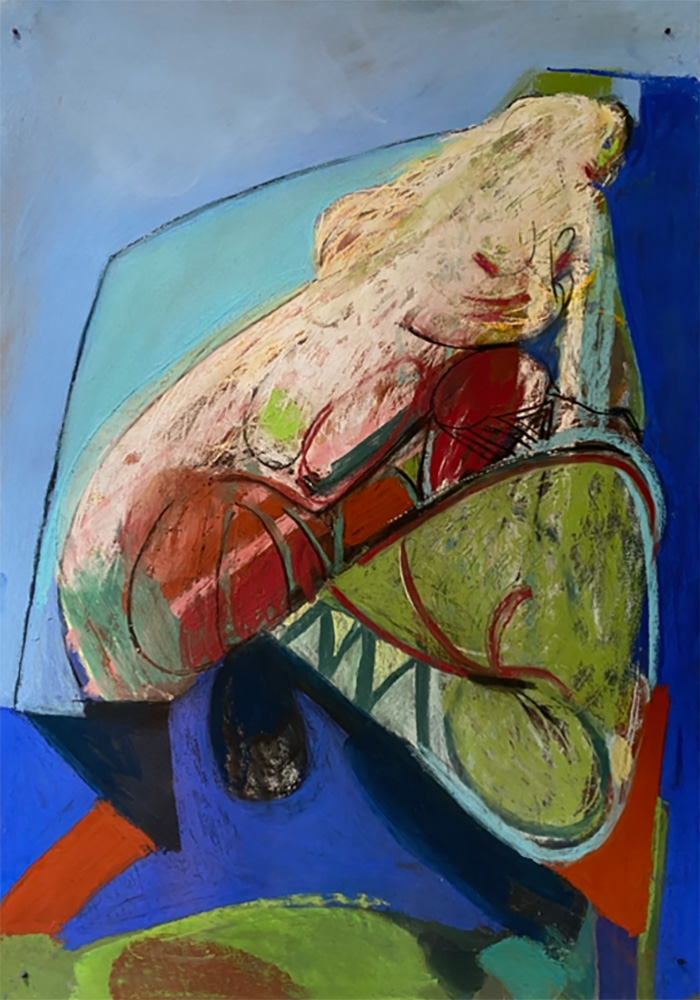
1. The original concept.
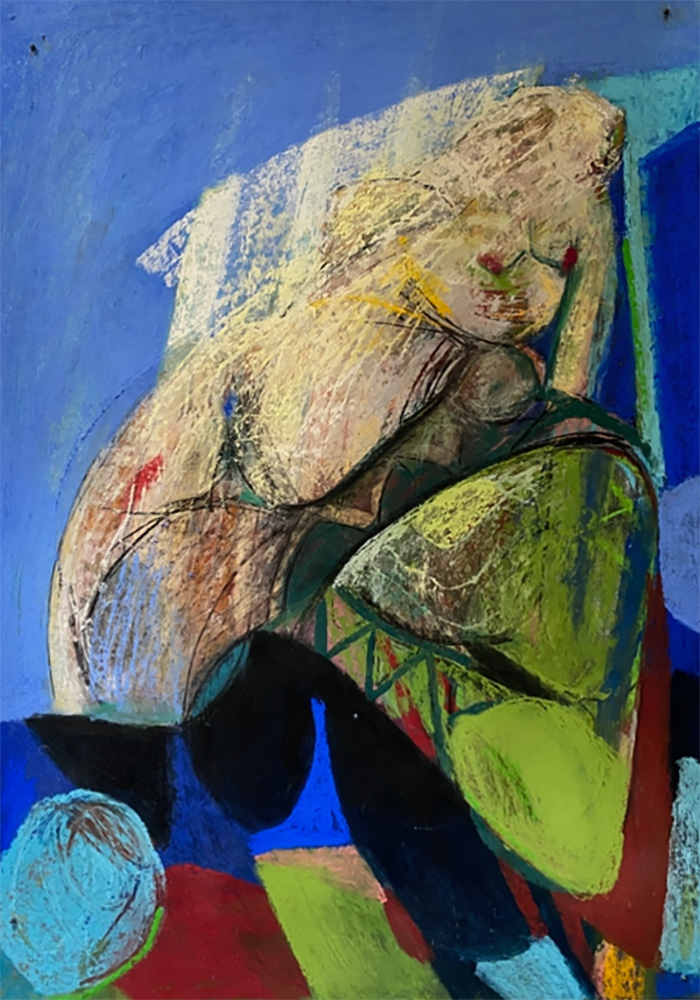
2. Midway.
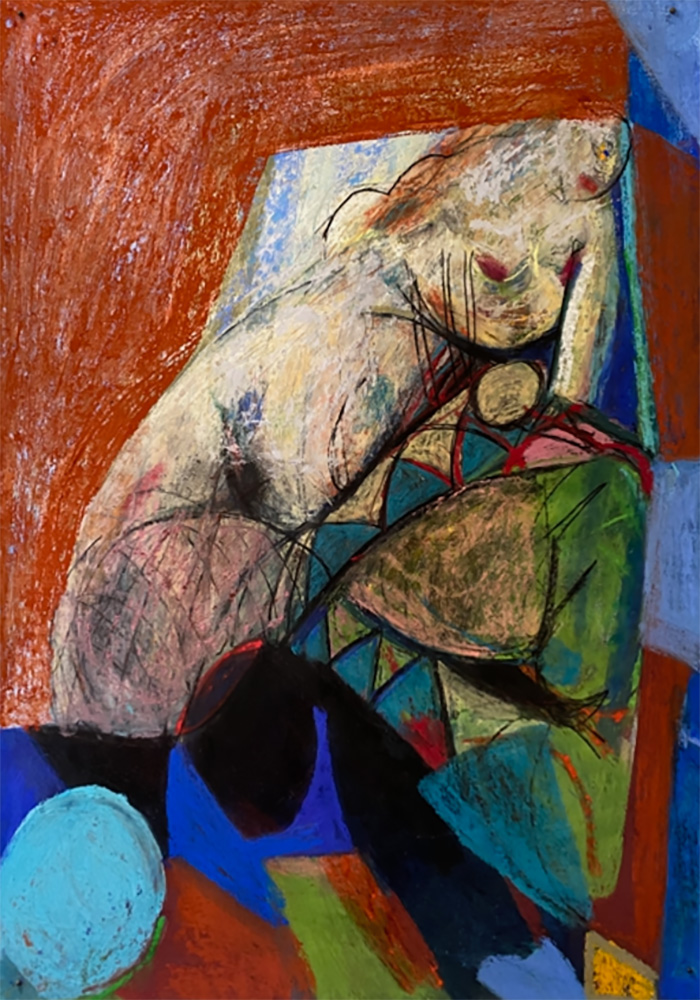
3. Final image.
LORRAINE FERNIE
NOVEMBER 2025
Statement
Using pastels on paper Lorraine Fernie creates images of single female figures.
The emphasis on weight, mass and movement in space make it immediately obvious that she has worked as a sculptor.
These figures, created from her imagination, are monumental and tactile with enormous energy and their own inner life.
History
My training was in Bauhaus-type problem solving and abstraction along with traditional painting and drawing from life. My main interest has always been in making images of human beings.
After graduation I started to carve in wood. Some of these sculptures were also functional objects but all grew out of an interest in the human figure.
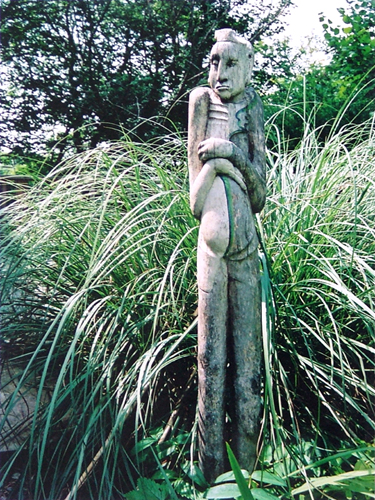
Guardian
Holly wood and household paint120x18cm
1982
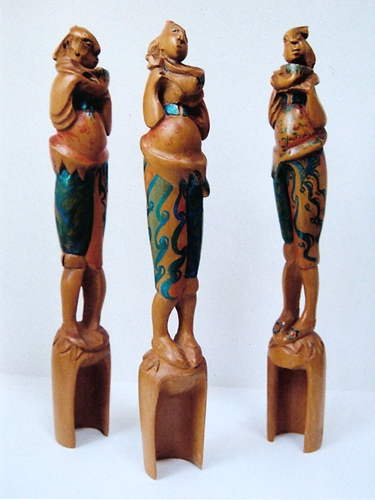
Gift Givers
Boxwood and enamel paint33x5cm
1983
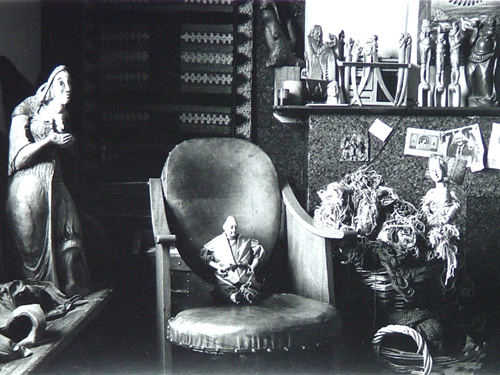
View of Workshop
1983In 1985 I changed to working with clay because it is a wonderfully malleable material. I made free-standing pots and then sculptures but many of my works at this time were modeled in relief and made to hang on walls.
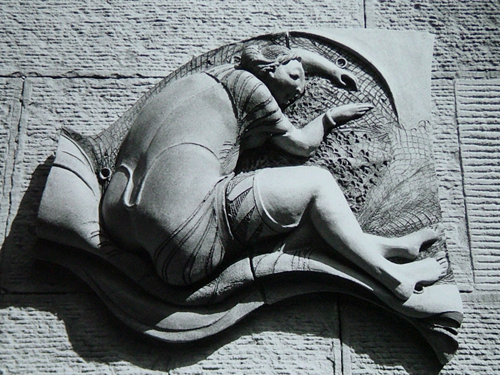
Female Figure
Carbon-stained stoneware60x50cm
1991
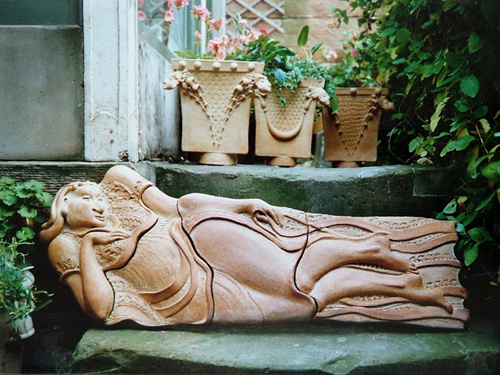
Ophelia
Unglazed stoneware100x40cm
1990
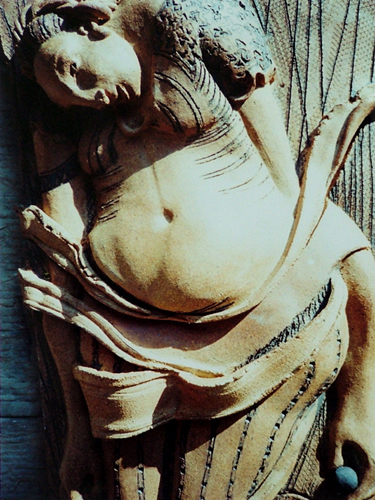
Reluctant Phoenix
Carbon-stained stoneware90x40cm
1992
In 1997 to gain more control over the colours than is possible when using traditional glazing techniques I began to paint my fired figures with acrylic paint.
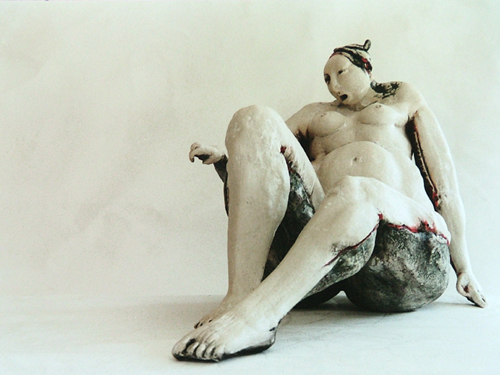
Female
White stoneware, acrylic paint, plaster of paris66x36cmcm
2000
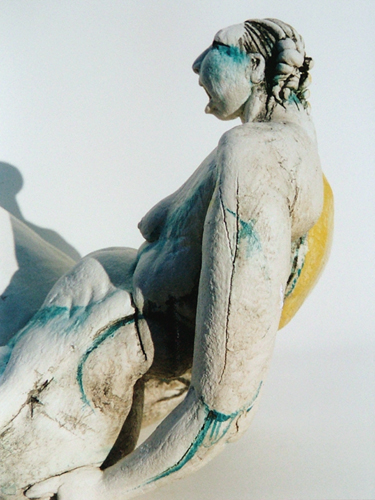
Female
White stoneware, acrylic paint, plaster of paris66x36cmcm
2000
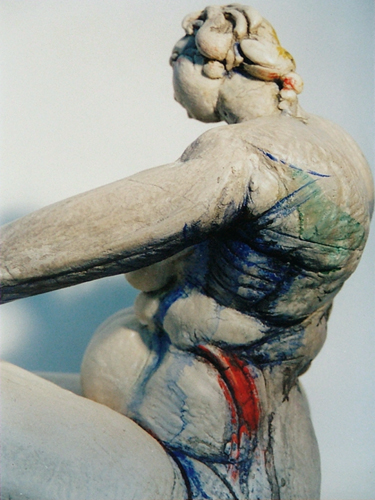
Female
White stoneware, acrylic paint, plaster of paris66x36cmcm
2000
Site by Counterwork